
Publication Date
November 6, 2026
Category
Cybersecurity Awareness
Reading Time
8 Min
Author Name
Shubh Arya
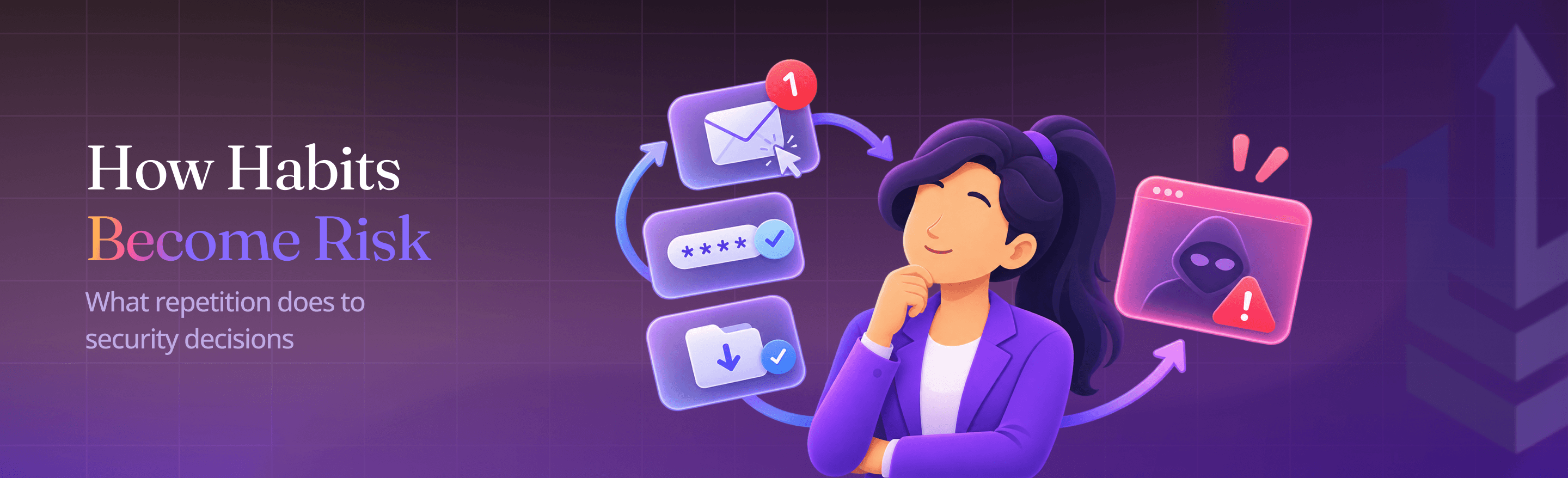
How Habits Become Risk: What Repetition Does to Security Decisions
Nobody decides to ignore a warning. They just stop seeing it.
Security culture is the set of habits people in an organisation share when nobody is checking: what they do with an odd request, an unexpected prompt or an inconvenient rule. It is built less by what is taught than by what is repeated, rewarded and made easy.
That definition puts the weight on repetition, so this essay follows repetition through five movements: repeat, reward, reflex, exploit and reset. Where the research is solid we say so. Where we are offering our own reading, we say that too.
Where habit sits in the Human OS
SimuPhish's Human OS framework describes six layers behind a security decision: cognition, emotion, bias, experience, habit and environment. Habit is the layer for what a person does automatically. It does not work alone, and that matters for everything below.
| Layer | Its part in a habit |
|---|---|
| Experience | Supplies the repetitions. What a person has met before, and how often, builds the pattern |
| Habit | Holds the pattern. The response that fires without a decision |
| Bias | Gives the shortcut its pull. Familiar and senior-looking things get less checking |
| Emotion | Sets the trigger. Urgency or worry makes the automatic response more likely to win |
| Environment | Decides whether the safe move is easy or costly. Workload, device, channel and team norms |
| Cognition | Supplies the attention to catch an exception, when there is any attention left |
1. Repeat: the warning that stopped working
In 2018, researchers at Brigham Young University published a study of what repeated security warnings do to the people who see them. In the lab, participants' attention to warnings fell across a five-day workweek, and it recovered partly between days when they were not exposed. In a three-week field test with app permission warnings, adherence to standard warnings fell substantially, while people who saw warnings that changed their appearance kept much higher adherence.
Two cautions. The research is from 2018 and is about warnings, not every kind of decision. We extend it carefully: if attention to a warning wears down with repetition, other repeated security prompts probably behave similarly. That is our inference. It fits what practitioners report, but it is an inference.
How long does a habit take to form? The best-known answer comes from a 2010 study at University College London, where 96 volunteers picked a new daily behaviour and rated how automatic it felt. The time to reach automaticity ranged from 18 to 254 days, with a median of 66. The behaviours were things like eating fruit or taking a walk, not security tasks, so treat it as a guide to how slowly habits move, in either direction.
2. Reward: the approval that cost nothing
Every time a person approves something and nothing bad happens, the approval was, in effect, rewarded. Click the link, nothing. Approve the sign-in prompt, nothing. Share the file, nothing. Each quiet success makes the next approval a little faster and a little less examined.
This is our interpretation, drawn from how habits are generally described, not a finding from a security study. It explains something training struggles with: the safe action usually has no visible payoff, while the unsafe one saves time right now.
3. Reflex: what pressure does to the pause
Researchers at Pacific Northwest National Laboratory studied how 153 employees responded to simulated phishing emails in 2023. They found that how stressed a person felt in the moment was associated with how likely they were to click. A pause that works at a calm desk can vanish when a message lands in the middle of a deadline.
This is the point where emotion and environment overrule cognition. The Human OS white paper makes the same argument with its 4:58 PM problem: the employee knows the rule, and the rule still has to compete with workload, an apparent senior sender and a deadline. Knowing is stored in one place. Doing under pressure is run from another.
4. Exploit: borrowing the habit
Attackers do not need to break a habit. They need to look like it. An industry report on email threats for the second quarter of 2026 found that malicious voice-call attempts on Teams ran at about ten times the level of mid-2025, and that the most common lure was a fake IT help desk warning about an account lockout. ENISA's 2026 threat landscape describes the ShinyHunters group using vishing in which callers impersonated IT staff to steal single sign-on credentials and MFA codes.
Why would that work? Our reading is that years of real help desk contact have taught people a rule of thumb: when IT calls, comply. The scam borrows a habit the organisation built, and the bias layer does the rest, because a familiar role and a calm voice get less checking.
5. Reset: three levers
If habits are the problem, the answer is not another reminder. It is to change the conditions that produce the habit. Three levers do most of the work.
| Lever | What it means | An example | Layer it works on |
|---|---|---|---|
| Change the default | Make the safe action the easy one | Reporting a suspicious message in one step. A help desk script that verifies every caller the same way | Environment, Habit |
| Change the friction | Add a deliberate pause only where the stakes are high | A second approver for new payees and changed bank details. | Cognition, Environment |
| Change the feedback | Reward reporting, not silence | Tell people what happened to their report. Count reports as success, not as noise | Experience, Emotion |
The white paper describes the same idea as a loop: a realistic experience, immediate feedback, reflection and repetition, varied across channels so the principle (pause, verify, report) transfers. That is a proposal from SimuPhish, drawing on general habit-formation research, and not a proven security-specific method. We include it because it matches what the three levers do in practice.
Expect it to be slow. Practitioners surveyed for a 2026 industry report on security awareness and culture say building a lasting security culture takes just over four dedicated staff and five to ten years, and that most programmes fall short of the staffing needed. That is not a reason to wait. It is a reason to measure early, so you can see a habit move.
The habit audit
Use this with a team of any size. Answer from what actually happens, not what the policy says.
| # | Question | A weak answer looks like | Layer |
|---|---|---|---|
| 1 | What is the safest action when a request looks odd, and how many steps does it take? | More than one step, or nobody is sure | Environment |
| 2 | When did someone last report something that turned out to be harmless, and what happened to them? | Nobody remembers, or they were mildly teased | Emotion |
| 3 | Which prompt do people approve without reading? | Everyone knows one | Habit |
| 4 | Which rule do people work around because it is slow? | A rule people complain about but nobody has changed | Environment |
| 5 | Does the real IT help desk ever ask for something an attacker could also ask for? | Yes, such as a code read aloud | Bias |
Question 5 is the one that surprises people. If your genuine process looks like the attack, the attack is borrowing something you built.
If you would like the full framework behind these layers, download the Human OS white paper. To see how SimuPhish Human Risk Management+ measures habits across email, SMS, voice, QR codes and chat, visit the human risk management page.
See SimuPhish in actionFAQs
Related Articles
Security Awareness Metrics: From Counting Training to Measuring Behaviour
Completion rates are not behaviour. Use a four-rung ladder and an eight-metric scorecard to measure what your people actually do.
Nov 10•7 Min read

Why Awareness Training Alone Isn't Reducing Human Error
Annual awareness training alone is not reducing human error. Organizations need simulations, behavioral data, and adaptive interventions to measurably lower workforce cyber risk.
Jul 9•6 Min read

Security Awareness Training for SAMA Compliance: A Guide for Saudi Enterprises
Learn how Saudi enterprises can build a SAMA-compliant workforce with an AI-driven Human Risk Management Platform for cybersecurity awareness training, phishing simulations, and audit ready reporting.
Jun 16•9 Min read