
Publication Date
November 3, 2026
Category
Human Risk Management
Reading Time
7 Min
Author Name
Shubh Arya
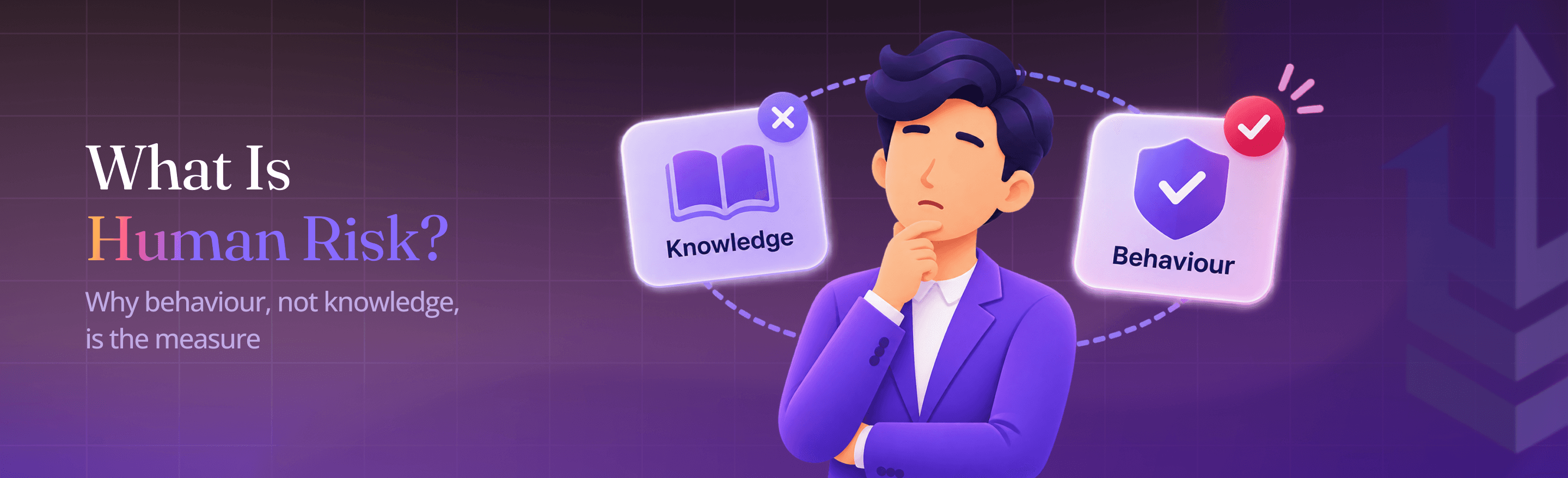
What Is Human Risk? Why Behaviour, Not Knowledge, Is the Measure
Human risk is the chance that something a person does at work, under real conditions, exposes an organisation to harm. The cause can be a mistake, a manipulation or a habit. It is measured by what people do, repeatedly, and not by what they know.
Most definitions stop there. The question worth asking next is why knowing a rule and following it so often come apart.
Two colleagues, one score
Picture two colleagues, Priya and Tom. Both finished the annual awareness course last month. Both scored 96 percent. On paper their risk is identical.
Now watch a quarter of realistic moments: a shared-file request that lands mid-deadline, a call from someone claiming to be IT, a text about a parcel, a chat message from a 'manager'. The figures below are an illustration we made up to show the point. They do not come from a study.
| Priya | Tom | |
|---|---|---|
| Course score | 96% | 96% |
| Moments tested | 4 | 4 |
| Acted on the request | 3 | 1 |
| Reported it | 0 | 3 |
| What the score says | Low risk | Low risk |
| What the behaviour says | Exposed, and invisible to the security team | Exposed once. The team heard about the other three |
The score cannot tell them apart. The behaviour can. And look at the last row: Tom's three reports are an early warning that protects everyone else, which a quiz score never captures.
Why knowing and doing part ways
The evidence that knowledge alone does not move behaviour keeps growing. In a study of more than 19,500 employees at a health system, researchers sent ten simulated phishing emails over eight months. They found no significant relationship between how recently someone had completed annual security training and whether they fell for a simulation.
Confidence is part of the gap. A 2026 survey of UAE residents, reported by Security MEA, found that 84 percent said they could recognise a scam, yet 38 percent said they consistently check URLs before clicking. The survey is self-reported and the report does not give a sample size, so read it as a signal, not a measurement. The shape is still familiar. People believe they know, and the habit lags behind the belief.
The Human OS white paper has a name for the moment this plays out: the 4:58 PM problem. A finance employee, tired, with a crowded inbox, gets a message that appears to come from a senior executive. It asks for a transaction to be processed before close of business. The employee knows the policy and may have passed a knowledge check last month. The question is not whether the rule exists in memory. It is whether the rule gets retrieved, and applied, at 4:58 on a Friday.
The six layers behind a decision
SimuPhish calls its way of describing that moment the Human OS. It is a framework we propose, informed by behavioural and human-centred security research, and a practical metaphor rather than a claim that the brain works like software. It describes six layers that shape what a person does at the point of decision.
| Layer | What it covers | How it shows up at work |
|---|---|---|
| Cognition | Attention, memory, pattern recognition | A person only notices what their attention has room for. A mismatched sender address gets missed in a crowded inbox |
| Emotion | Fear, curiosity, trust, urgency | A 'deadline today' message narrows the time for thought. Flattery and worry do the same |
| Bias | Mental shortcuts | A familiar logo signals legitimacy. A senior name signals authority. Useful shortcuts that attackers aim at |
| Experience | What a person has met before | Someone who has practised verifying a payment change recalls the move faster than someone who has only read about it |
| Habit | What a person does without deciding | Approving the prompt, replying in the same thread, or pausing and checking another way. |
| Environment | Workload, role, device, channel, culture | The same person responds differently on a phone, on a Friday, in a team where reporting is mocked or rewarded |
Awareness training mostly works on what people know. Attackers, in our view, design for the other layers: the pressure, the shortcut, the routine. That is a reason to measure more than training, not a criticism of it.
The four kinds of human risk
'Human risks' is often used as a single bucket. It helps to separate four, because each needs a different response.
| Kind | What happens | What helps most |
|---|---|---|
| Mistake | A careful person slips: wrong recipient, wrong attachment, wrong setting | Better defaults, confirmation steps, easy undo |
| Manipulation | A skilled attacker builds a story that makes a harmful action feel normal (see pretexting) | A verification habit, practised across channels |
| Habit | A shortcut that usually works becomes the default, until the day it does not | Change the conditions and the feedback, not just the knowledge |
| Deliberate misuse | A person knowingly breaks the rules or abuses access | Access controls, monitoring, a different programme (insider threat) |
What human risk is not
It is not blame. ENISA's Threat Landscape 2025, covering nearly 4,900 incidents from July 2024 to June 2025, found phishing was the primary intrusion vector at 60 percent. That describes where attacks meet a person. It does not say the person caused the breach.
It is not a completion rate. Finishing a course shows that time was spent, not that behaviour changed.
It is not a single click rate. One number from one lure describes the lure at least as much as the people.
How human risk is measured
Measure what people do, in situations that resemble the real thing. The Human OS white paper lists seven things worth tracking: reporting behaviour, response speed, repeat patterns, role and exposure, scenario difficulty, channel resilience and improvement trend. No single number sums them up, and the paper says so. Look at spread as well as the average, because risk tends to sit in particular teams, roles and moments.
What to do with this
Ask for behaviour numbers, not just completion. Start with report rate.
Test beyond email. Attackers do not stay in one channel, and your tests should not either.
Treat a report as the success signal. A person who reports is doing the job.
Give it time. Practitioners surveyed for a 2026 industry report on security awareness and culture say changing workforce behaviour takes at least three dedicated staff and three to five years. That is a reason to begin measuring now.
Human risk management is the discipline of doing this on purpose. SimuPhish Human Risk Management+ tests across email, SMS, voice, QR codes and chat in more than 75 languages, and shows how risk moves across individuals, teams and regions. To see the full framework, download the Human OS white paper.
See SimuPhish in actionFAQs
Related Articles
How to Report Human Risk to the Board: A One-Page Template
Boards want cyber risk in business terms. Use a one-page human risk report, the questions directors ask, and wording that works.
Nov 16•9 Min read

How Distributed Workforces Should Approach Human Risk Management
Distributed teams face different languages, threat patterns, and cultural behaviors. Learn how organizations can approach Human Risk Management with localization, continuous measurement, and region-specific cyber resilience.
Jul 16•6 Min read

Features a Cyber Risk Platform Needs for an APAC Bank
APAC banks face rising phishing, fraud, compliance, and cross-border cyber risk. Here are the key features a cyber risk management platform should have to help financial institutions measure and reduce human cyber risk at scale.
Jul 9•7 Min read