
Publication Date
October 24, 2026
Category
Social Engineering Tactics
Reading Time
7 Min
Author Name
Shubh Arya
What Is Pretexting? The Story Behind Every Scam
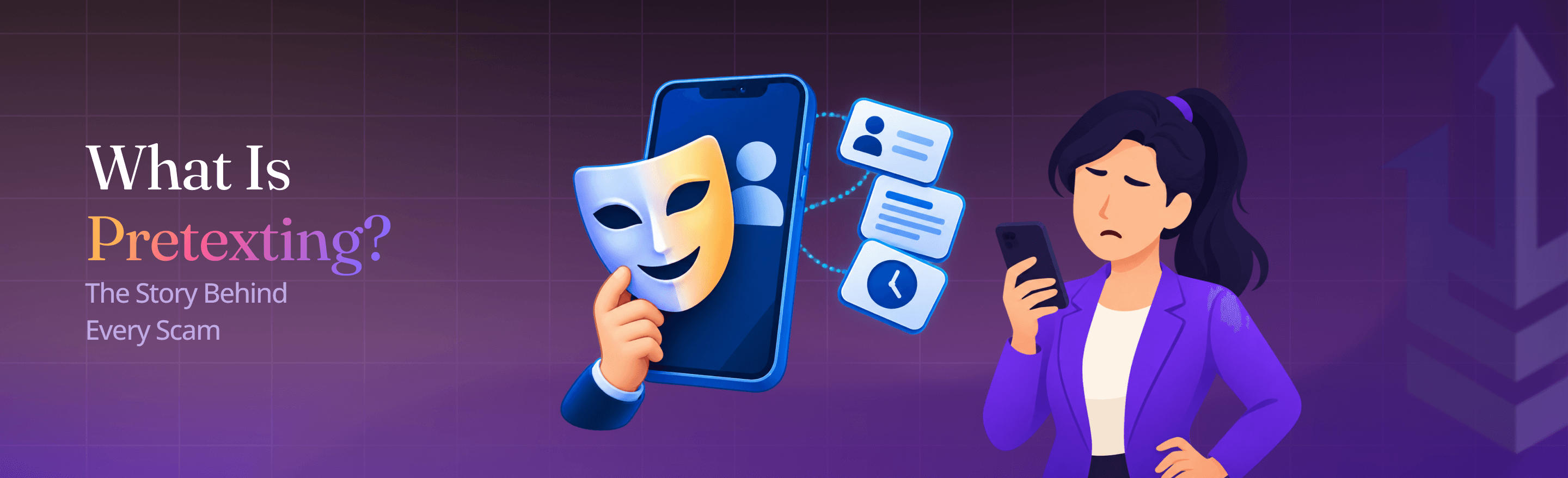
<pre><pre><pre><pre>Pretexting is a social engineering technique in which an attacker invents a believable story, and often a false identity, to persuade someone to hand over information, access or money. The story is the attack. Everything else, the email, the call, the fake profile, is only the delivery.
Pretexting scams rely on a fabricated scenario and a false identity that earn the target's trust, usually reinforced by pressure such as authority or urgency.
That definition explains why pretexting is so hard to catch with technology. A pretext does not need a malicious link. It needs a character who seems to have a good reason to ask.
Pretexting vs phishing: story vs delivery
People often treat these as rivals. They are better seen as layers. Phishing, vishing and smishing describe how a message arrives. Pretexting describes what it says. A phishing email with a convincing invented backstory is both.
| Pretexting | Phishing, vishing, smishing | |
|---|---|---|
| What it is | The invented scenario and identity | The channel the message travels through |
| Needs a link or file? | No | Often, but not always |
| What detects it | A person asking whether the story holds up | Filters, scanners, blocklists, plus people |
| Where you see it | Help desk calls,urgent requests from 'executives', 'vendors' changing details | Email, phone, text |
The five parts of a pretext
Looking at real cases side by side, we found the same five parts in each. This is our own framework, not an industry standard, but it makes stories much easier to take apart.
| Part | What it is | Why it works |
|---|---|---|
| Character | Who the attacker claims to be | People help colleagues, bosses and officials |
| Prop | Something that makes the character real: a photo, a voice, a name, a detail from social media | A small true detail makes the rest feel true |
| Reason | The believable situation behind the call | A reason removes the need to ask why |
| Squeeze | Pressure such as urgency, secrecy or authority | Pressure shortens thinking time |
| Ask | The one thing they want | Often small and reasonable on its own |
Five cases, one framework
| Case | Character and prop | Reason and ask | Outcome |
|---|---|---|---|
| HP investigation, 2006 | Investigators using false pretences with phone companies | Obtain board members' and journalists' call records to trace boardroom leaks | Exposed in late 2006. The US FTC later sued the contractors and a court barred them from pretexting for phone records |
| UAE bank, 2020 | A cloned voice of a company director the bank manager already knew | A pending acquisition that needed money moved. Ask: authorise transfers of about 35 million dollars | Transfers approved. Some case details remain unpublished |
| Scattered Spider, 2023 onwards | Callers posing as IT staff, or as employees phoning the help desk, using details from social media and data leaks | A locked account or an alert. Ask: a password reset, a one-time code, or a move of the employee's sign-in method to the caller's device | Documented by CISA as a recurring method |
| Ferrari, 2024 | A WhatsApp account and then a call imitating the CEO's voice and accent | A supposed China-related deal needing a currency hedge transaction | Failed. The executive asked for the title of a book the CEO had recently recommended, and the caller hung up |
| WPP, 2024 | A fake WhatsApp account using the CEO's public photo, then a Teams call with a voice clone and video footage of him | Set up a new business venture. Ask: money and personal details | Failed. WPP credited staff vigilance |
Notice what is missing from the table: no malware, no exploit, no software flaw. Every case is a story told well, to someone who had no easy way to check it in the moment.
Also notice that the two cases that failed were stopped by people who did something small and slightly awkward. At Ferrari, the executive asked a question the fake could not answer. At WPP, the company credited staff vigilance.
The 30 second story audit
When a request is unexpected, run it through five questions before acting. None needs technical skill.
| Question | What you are checking |
|---|---|
| 1. Who exactly is asking, and how do I know? | The character. Can I confirm the identity another way? |
| 2. What makes them seem real? | The prop. Anything a stranger could find online proves nothing. |
| 3. Why now, and why me? | The reason. Would this normally come to me, by this route? |
| 4. What happens if I wait an hour? | The squeeze. Real deadlines survive a phone call back. |
| 5. What exactly do they want? | The ask. Is it money, a code, access or secrecy? |
If two answers are weak, stop and verify through a channel you started yourself, such as a number from your own records. This is the single move that defeats most pretexts, because the attacker controls the story but not your phone book.
What organisations can change
Treat the help desk as a front line. CISA describes attackers phoning IT staff while posing as employees, and asking for password resets or a change of the employee's sign-in method. A fixed verification routine that does not rely on easily found personal details closes much of that gap.
Shrink the prop supply. A review of the digital footprints of hundreds of executives found that around 60 percent of an individual's exposure could be found with an ordinary web search. Reviewing what staff and leaders publish removes material from attackers.
Make verification polite and normal. People skip checks that feel rude. A written rule that everyone verifies, including requests from the CEO, takes the awkwardness out.
Practise with realistic stories, not just links. Simulations that tell a believable story across email, phone and messaging are closer to the real thing. SimuPhish builds scenarios across those channels so teams can rehearse the pause.
See SimuPhish in actionFAQs
Related Articles
ClickFix Attacks: How Fake CAPTCHAs Turn Everyday Habits Into Malware
ClickFix tricks people into running malware themselves with a fake CAPTCHA or error. See how it works, why habits make it succeed and how to stop it.
Oct 30•6 Min read
CEO Fraud: How It Works and a Payment Pause Protocol You Can Adopt This Week
CEO fraud now arrives by email, call and video. Learn how it works and use a one-page Payment Pause Protocol your finance team can adopt this week.
Oct 26•7 Min read
The Cost of a Convincing Video Call: BEC in 2026
Business email compromise now arrives by video call too. See how the $25M Arup deepfake and the FBI's 2025 figures changed BEC, and what to ask before a wire.
Sep 15•5 Min read