
Publication Date
October 22, 2026
Category
Phishing Simulations
Reading Time
7 Min
Author Name
Shubh Arya
What Is Vishing? A Scam Call Decoded Line by Line
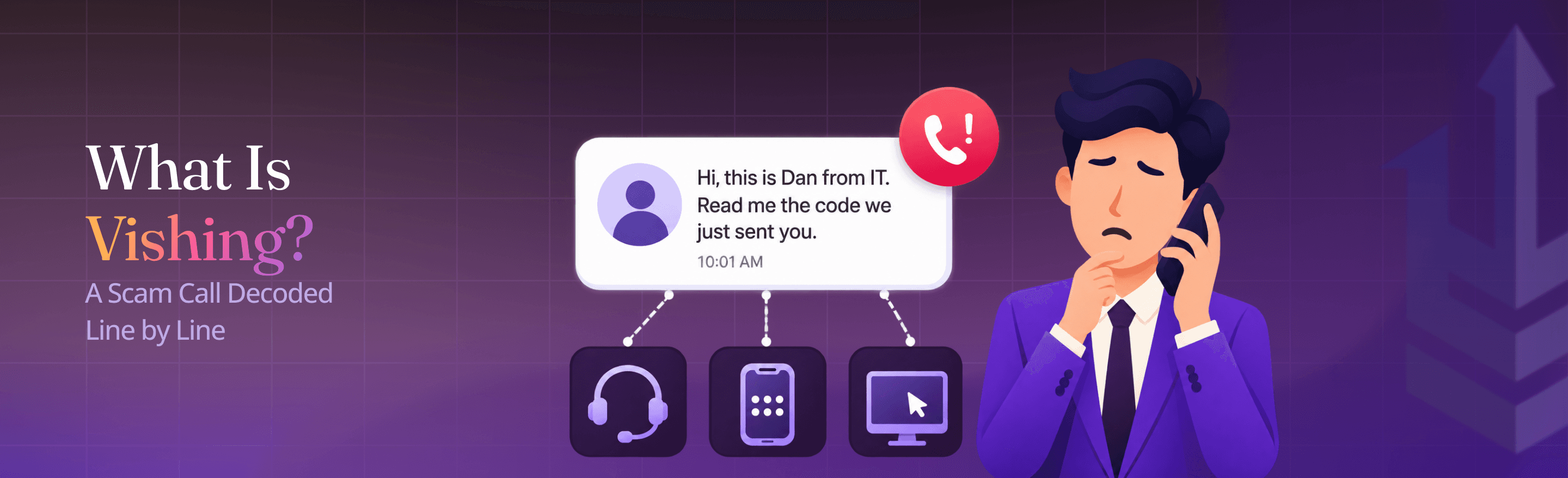
<pre><pre><pre><pre>Vishing, short for voice phishing, is a scam in which an attacker phones or leaves a voice message to trick someone into handing over information, money or access. The caller pretends to be a bank, a supplier, an IT help desk or a senior colleague, and uses pressure to rush the decision.
That is the definition. The more useful question is what it sounds like, because vishing rarely announces itself. It sounds like a helpful person with a small problem to solve.
Listen to one call
The call below is a composite we wrote to show the pattern. It is not a recording of a single case. It follows the approach the US cybersecurity agency CISA describes for the Scattered Spider group, whose members called staff pretending to be IT or help desk workers, asked for one-time sign-in codes and steered people towards remote access tools.
| What the caller says | What the line is doing |
|---|---|
| "Hi, this is Dan from the IT service desk. We have flagged a security alert on your account." | Borrows authority and gives a reason for the call. If there is an alert, the call feels expected. |
| "It is nothing to worry about. I can clear it in two minutes. Are you at your computer?" | Reassures, then makes a tiny request. Saying yes commits you to staying on the line. |
| "I have just sent a code to your phone. Read it back so I can confirm it is you." | Asks for the one-time code that protects your account. The caller is signing in as you while you talk. |
| "Great. To finish, I need a quick remote session. Can you open the link I am sending?" | Moves from information to access. A remote tool lets the caller work on the machine directly. |
| "We need to finish before the 5 pm cut-off or the account locks." | Adds a deadline, so slowing down feels like the risky choice. |
Nothing in those five lines is technical, and none would trip an email filter, because there is no email. The whole attack is a short conversation with a calm, competent person.
Why a phone call works so well
A live person adapts. In callback phishing, the scammer can answer questions and overcome objections in real time, which a web page cannot do.
Voice carries trust. In early 2020 a bank manager in the United Arab Emirates approved a transfer of about 35 million dollars after a call from a voice he recognised as a company director. Court documents reported by Forbes say the voice was a clone. Some details of the case, such as the parties, have not been made public.
The cloning barrier is low. Consumer Reports tested six voice cloning products in 2025. Four had no technical check that the speaker had agreed, and a few seconds of public audio was enough to build a clone.
Nobody sees it. A call happens on a phone, outside the systems your security team watches, so it only surfaces if the employee reports it.
Four kinds of vishing call
| Type | How it starts | What it asks for |
|---|---|---|
| Help desk call | A caller posing as IT, or as an employee phoning IT | A password reset, a one-time code, or a move of the employee's sign-in method to a device the caller controls |
| Callback phishing (TOAD) | An email with no link, only a phone number. The victim calls | Personal details, remote access, or approval of a payment |
| Executive voice clone | A call or voice note that sounds like a senior leader | An urgent payment or a confidential favour. This is the phone version of CEO fraud |
| Authority call | A caller posing as a bank, a regulator or a supplier | Account details, codes or a transfer |
Callback phishing, also called telephone-oriented attack delivery or TOAD, deserves a note of its own. The email looks like a receipt, an invoice or a subscription renewal for a charge you do not recognise, and the fix is a phone number. Examples have included fake PayPal and Geek Squad notices and a calendar invitation warning of an automatic debit within 12 hours. Because there is no link or file, the email part is hard for filters to judge. The scam only begins when the victim dials.
Vishing vs phishing vs smishing
| Phishing | Vishing | Smishing | |
|---|---|---|---|
| Channel | Phone call or voice message | Text message | |
| What a filter can inspect | Links, files, sender | Almost nothing | Links, sender number |
| Pressure comes from | A deadline in the message | A live person's voice and pace | A short, urgent text |
| Typical ask | Click, sign in, open | Read out a code, install, pay | Tap a link, confirm a delivery |
They share a goal, which is to get you to act before you think. Vishing is the one where the attacker can hear your hesitation and respond to it. Read more in What Is Smishing?
How to stop a vishing attempt
The habits below work for anyone. For a programme-level view of training staff against phone and text scams, see How to Stop Employees Falling for Vishing and Smishing Scams.
For everyone
End the call and ring back on a number you already hold: the card in your wallet, the company website you typed in, the number in your own records. Never use a number the caller or a message gave you.
Never read out a one-time code. A real support agent does not need it.
Never install software or open a link because a caller asked.
Treat a deadline as a reason to pause, not a reason to hurry.
If you gave something away, say so quickly. Tell your IT team or your bank straight away, from a different device if you can. Speed limits the damage.
For security and IT teams
Give the help desk a fixed way to verify a caller before any password or sign-in reset, that does not rely on information found on social media. CISA says attackers gather such details from social media and data leaks to sound convincing, and that calls may run over several conversations.
Move towards sign-in methods that cannot be talked out of someone. CISA advises phishing-resistant multi-factor authentication, such as FIDO or WebAuthn, which a one-time code read over the phone cannot defeat.
Include voice in your training and testing. A programme that only tests email leaves the phone channel untested.
make reporting simple. A reported call is an early warning for everyone else.
SimuPhish runs voice phishing simulations alongside email, SMS and other channels, so teams can practise the pause on the channel where pressure is highest.
See SimuPhish in actionFAQs
Related Articles
The Meeting Invite That Wasn't: Inside a State-Backed Phishing Campaign
Calendar invite phishing uses a real Microsoft login page to take over accounts. See how Storm-2372's device code campaign works and why the Gulf is a target.
Sep 23•5 Min read
Why QR Codes Are Now a Board-Level Blind Spot
Quishing hides phishing links in QR codes to slip past email filters and MFA. See how the FBI's Kimsuky warning changed the threat, and what to ask your team.
Aug 20•4 Min read
What Is Smishing? A Guide for Security Teams
Smishing is phishing delivered by SMS. Learn how attackers impersonate banks and couriers, real examples from the US and UAE, and how security teams defend against it.
Aug 18•6 Min read