
Publication Date
October 30, 2026
Category
Social Engineering Tactics
Reading Time
6 Min
Author Name
Shubh Arya
ClickFix Attacks: How Fake CAPTCHAs Turn Everyday Habits Into Malware
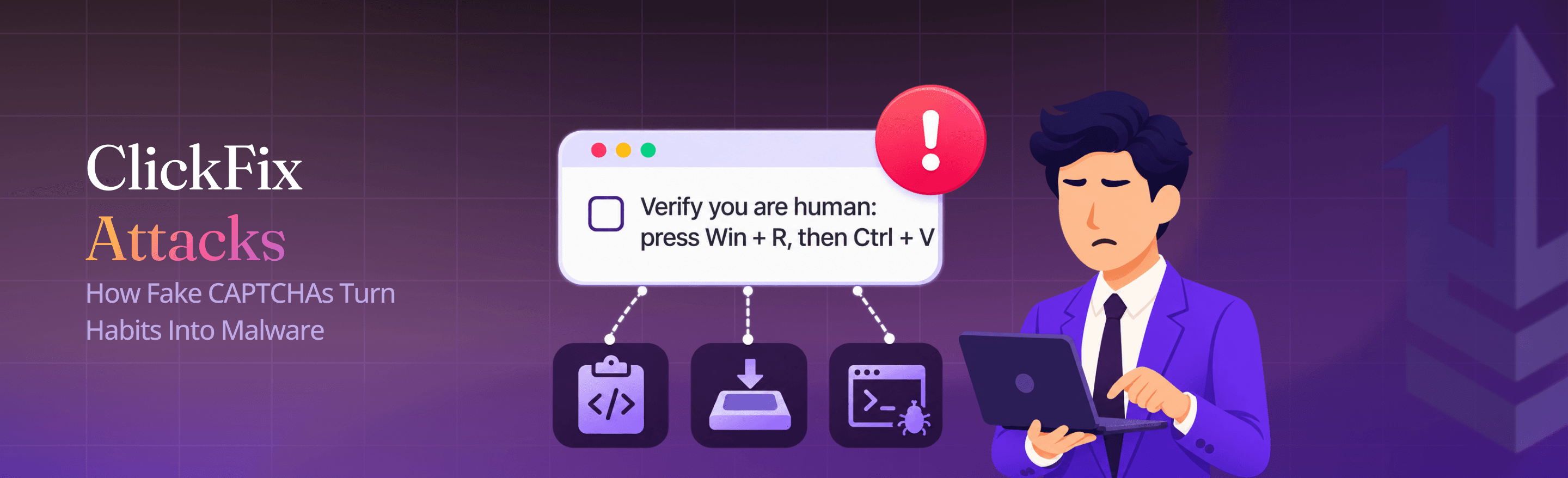
<pre><pre><pre><pre>ClickFix is a social engineering attack that shows a fake error message or verification check and tells the visitor to copy a command and run it on their own computer. The victim, not the attacker, installs the malware, which is why the attack slips past many of the tools that guard against downloads and attachments.
It sounds too crude to work. It works because of something quieter than a technical trick: a decade of habits.
How a ClickFix attack unfolds
The UAE Cyber Security Council described the technique in a May 2025 alert. In its account, it follows four steps:
A fake prompt appears on a malicious or compromised website. It may look like a CAPTCHA, a browser update, a missing document plugin or a video call hardware error.
A button quietly copies a command to the clipboard.
The page instructs the visitor to open the Windows Run box or search bar and paste.
The command runs with the user's own privileges, and downloads malware or opens a remote access channel.
No software flaw is needed. No file is downloaded by the browser. The user carries out the last step.
Why it is growing
Industry threat research for the first half of 2025 reported that ClickFix use rose by more than 500 percent compared with the second half of 2024, making it the second most common attack vector after phishing, at nearly 8 percent of the attacks blocked. The payloads varied widely, from information stealers to ransomware, and the technique reached Windows, Linux and macOS.
It keeps evolving. Reporting summarised in February 2026 described a variant that tells victims to run a command which performs a DNS lookup to fetch the next stage, apparently because security tools increasingly block the more familiar commands. Another variant reported in early 2026, nicknamed CrashFix, deliberately crashes a browser and then offers a command as the cure.
The habit map
Here is our interpretation of why ClickFix and its relatives work. Every day, people carry out dozens of small rituals on autopilot: tick the box, accept the cookies, approve the sign-in, install the update. Each one has taught the brain a rule of thumb, which is that when a screen asks, comply. Attackers copy the ritual. This is our own analysis, not a research finding, but it explains the pattern.
| The everyday ritual | What it has taught us | The attack that copies it |
|---|---|---|
| Tick the CAPTCHA box to prove you are human | Verification prompts are routine and quick | ClickFix fake CAPTCHA that asks you to paste a command |
| Approve the sign-in notification on your phone | Approve to make the interruption go away | Push bombing, also called MFA fatigue, where attackers send repeated prompts until someone accepts |
| Install the browser or app update | Updates are normal and the screen tells me how | Fake update prompts, one of the variants listed by the UAE Cyber Security Council |
| Follow the on-screen steps to fix an error | Error messages come with instructions to follow | CrashFix and fake error variants that supply the 'fix' |
The second row connects to a pattern CISA documented. Scattered Spider sent repeated multi-factor approval prompts until an employee accepted one, a method known as push bombing or MFA fatigue. The common thread is that the attack does not break the control. It trains on the person who operates it.
This is the thinking behind repeated decision conditioning, a concept in SimuPhish's Human OS framework: choices people make many times become reflexes, and reflexes can be borrowed. Human OS is a proposed framework, not a clinical model.
Why awareness training often misses it
Most programmes teach people to be wary of links and attachments. ClickFix has neither. Like QR code phishing, it slips past the checks people have been taught to run on links. The warning signs people have learned, such as a strange sender or a suspicious link, may be absent entirely. The only unusual element is a page asking the visitor to run something themselves.
That makes the rule simple. It also makes it worth saying out loud, because many people have never been told it.
The one rule
A web page should never ask you to copy something and paste it into Run, PowerShell or Terminal. If one does, close it.
Legitimate verification checks do not need you to open system tools. If a page says you must press a key combination and paste, it is an attack. Close the tab and report it.
What staff should do
Close the page. Do not paste anything.
Report it through your normal channel, even if nothing was run.
If something was pasted, tell IT immediately and disconnect from the network if you can. Speed limits the damage.
What IT teams can do
The UAE Cyber Security Council advisory suggests technical and human measures. These are for your IT team to implement:
Restrict PowerShell for users who do not need it, using application control, and consider constrained language mode.
Block or monitor the Windows Run dialog through policy or endpoint protection.
Filter suspicious HTML attachments and links at email and web gateways.
Use endpoint detection to flag unusual command line activity, for example PowerShell launched straight after a user interaction.
Add a rule to the acceptable use policy that staff must not run commands from unsolicited sources, and provide a simple way to report.
What this means for awareness programmes
If your simulations only send links, they train people for yesterday's attacks. Add scenarios in which a page, not an email, asks the user to do something unusual. Measure the report rate, because a reported ClickFix attempt is how the next person gets protected. SimuPhish simulates attacks across email, SMS, voice and messaging apps, and its one-click reporting is designed to make the reporting step easy.
See SimuPhish in actionFAQs
Related Articles

CEO Fraud: How It Works and a Payment Pause Protocol You Can Adopt This Week
CEO fraud now arrives by email, call and video. Learn how it works and use a one-page Payment Pause Protocol your finance team can adopt this week.
Oct 26•7 Min read
What Is Pretexting? The Story Behind Every Scam
Pretexting is a made-up story told to get something from you. Five real cases, one framework, and a 30-second test that exposes the story.
Oct 24•7 Min read
The Cost of a Convincing Video Call: BEC in 2026
Business email compromise now arrives by video call too. See how the $25M Arup deepfake and the FBI's 2025 figures changed BEC, and what to ask before a wire.
Sep 15•5 Min read